Wednesday, July 16, 2008

"Unconquerable Afghans": What the Globe and Mail publishes and does not

Post done at Babbling's urging (from a comment here). A letter sent to the Globe July 13 and not published:
Afghans not unconquerable

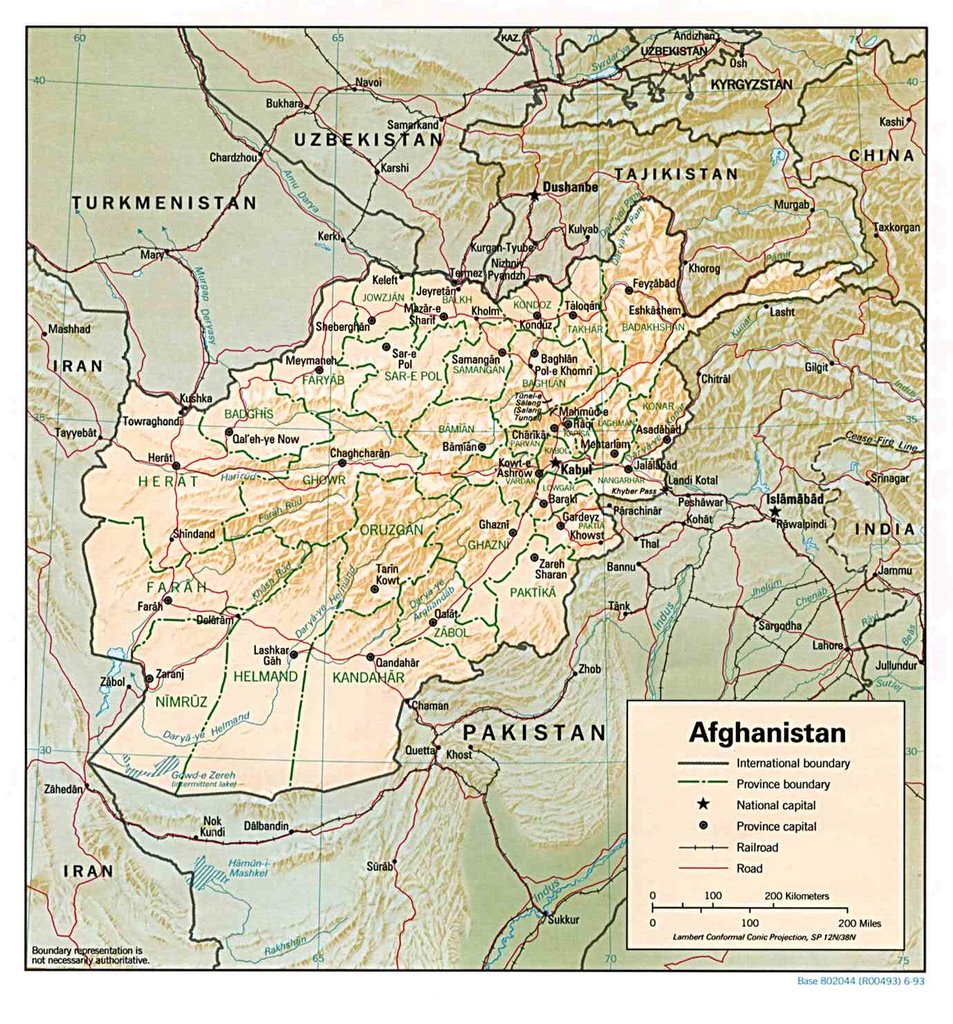
The story 'It's impossible to conquer the Afghans' (July 12) is accompanied by a box [at bottom here] that states "Many foreign forces have attempted to conquer Afghanistan and its predecessor states. Few have succeeded." The box however gives a very selective reflection of Afghan history, as it deals with only five examples over some 2,500 years.

Indeed, during just the last millenium or so Afghanistan has been conquered several times. Some examples (all Turkic peoples except the Iranians): the Ghaznavids (962 - 1186), the Timurids (1369 - 1506--Tamerlane et al.), then the Moghuls followed by Iranians (1504 - 1709).

Perhaps the most noteworthy thing about Afghan history is that a recognizably Afghan independent state did not arise until one was formed by Ahmad Shah Durrani in 1747. The remarkable fact, contrary to popular myth, is actually how often Afghanistan has been under foreign rule.

References:

http://www.afghanan.net/afghanistan/ghaznavids.htm
http://www.afghanan.net/afghanistan/timorids.htm
http://www.afghanan.net/afghanistan/moghuls.htm
http://www.afghanan.net/afghanistan/durrani.htm
http://www.afghan-web.com/history/chron/index2.html
http://www.state.gov/r/pa/ei/bgn/5380.htm
But they did just publish this:
Superpower messiah syndrome

ANDREY SHAKHMETOV

July 16, 2008

The Hague -- Re 'It's Impossible To Conquer The Afghans' (July 12): I had two tours of duty in Afghanistan, 1982 and 1984-1986, as an intelligence officer. For an ordinary Afghan person, any foreign interference is an attempt to "conquer," be it under communist or democratic slogans. That's why free elections (even if they were to be so) won't change the situation.

Superpower messiah syndrome is a very dangerous thing for both "conqueror" and "conquered"!
Draw your own conclusions.

Wednesday, December 09, 2009

Kabul: They sure Khan...

...Deploy By The Horde (via The Thunder Run). Though not quite like an earlier effort (for all those who adhere to the myth of the "unconquerable Afghans".

Friday, July 17, 2009

Still a good war

A post byBruceR at Flit:
Reasons for positive thinking

I and others may cavil about long-term sustainability of our plans, or note disappointment wastes of time or money, or wonder aloud whether our priorities as Afghanistan's allies need to be re-ordered a little. But there can be no question that Afghanistan is still on the whole a nicer, safer place than it was in 2001, or 1991 for that matter. Kabul is booming. And Peter Bergen is right that the majority of Afghans' war for a better future for themselves is far from lost, for reasons he aptly outlines here. The cause that we committed to, and in which Canadians continue to die, is still a just one. If I didn't continue to believe that, I frankly wouldn't care about the problems that have been identified as much as I do.

From the Bergen piece:
...
Objections to Obama’s ramp-up in Afghanistan begin with the observation that Afghanistan has long been the "graveyard of empires"—as went the disastrous British expedition there in 1842 and the Soviet invasion in 1979, so too the current American occupation is doomed to follow. In fact, any number of empire builders, from Alexander the Great to the Mogul emperor Babur in the sixteenth century to the British in the Second Afghan War three decades after their infamous defeat, have won military victories in Afghanistan. The graveyard of empires metaphor belongs in the graveyard of clichés [emphasis added]...
My bit on the "unconquerable Afghans" here, and more:
Jack Layton: Simply ignorant or just plain lazy?

Wednesday, August 06, 2008

'The Unbearable Idiocy of Certain American "Foreign Policy" Wonks'

Terry Glavin uses all the barrels in his GAU-8 Avenger Gatling pen:
Have a glance at Conn Hallinan's "Afghanistan: Not a Good War" in Foreign Policy in Focus and you will be subjected to an almost pornographic illustration of the craven, shallow and moronic habits of mind that prevail within what passes for the intellectual content of American "anti-war" polemics.

All in aid of the case for abandoning the Afghan people by simply assembling the more powerful nation-state powers in the region and cutting a deal with the Taliban, the column begins with a revisionist straw man, ends with a silly and meaningless platitude, and in between, almost every paragraph contains a non-sequitur, a logical fallacy, or an embarrassing, transparent error. It's simply so bad, so shallow, so wrong and so stupid, one wonders where to start...
Read on. I might add that, contrary to what Mr Hallinan writes, the Taliban did not exist when the Soviets left Afghanistan in 1989 and the US had nothing to do with their creation. The Taliban only emerged, in Pakistan with ISI help, in the early 90s during the Afghan civil war, in which the US had very little involvement. Moreover the US had no direct links with bin Laden (see Ghost Wars, Steve Coll). While the Taliban did not attack the US, they allowed bin Laden to do so, and several times: the Nairobi and Dar es Salaam embassy bombings, the USS Cole, 9/11.

Then there's the unconquerable Afghan myth . Tripe indeed.

Friday, February 01, 2008

Jack Layton: Simply ignorant or just plain lazy?

Further to Babbling's post, the following is from the CP article:
...
"It's an endless mission. There's no end in sight. We say it's a dead end," Layton told reporters Thursday.

"No one has laid out, anywhere, that it's possible to ultimately win a war in this region.

"No one. And historical experience shows that it's been impossible – whether it be Alexander the Great, the British in the 19th century, or the Russians in the 20th century.

"We're saying let's recognize these historical realities."..

Ah, the wonderful myth of the unconquerable Afghan. Some history: the present, independent, recognizably Afghan (Pathan) state was not created until 1747. Whoever controlled Persia/Iran controlled most of what is now Afstan much of the time ("Greater Khorassan"). The area was successfully conquered by outsiders, esp. of the Turkic persuasion, many times--a few highlights:
During the [Persian] Sassanid dynasty the province was governed by an Espahbod (Lieutenant General) called "Padgoosban" and four margraves, each commander of one of the four parts of the province.

Khorassan was divided into four parts during the Islamic Conquest of Iran and each section was named after the four large cities, such as Neyshabour, Merv, Herat, and Balkh.

In the year 651 CE, the army of Islamic Arabs invaded Khorasan. The territory remained in the hands of the Abbasid clan until 820 CE, followed by the rule of the Iranian Taherid clan in the year 896 CE and the Samanid dynasty in 900 CE.

Sultan Mohmud Qaznavi [Turkic] conquered Khorasan in 994 CE and in the year 1037 CE Toqrol, the first of the Seljuqian [Turkic] rulers conquered Neyshabour.

Mahmud Qaznavi retaliated against the invaders several times, and finally the Qaznavi Turks defeated Sultan Sanjar. But there was more to come, as in 1157 CE Khorasan was conquered by The Khwarazmids and because of simultaneous attacks by the Mongols, Khorasan was annexed to the territories of the Mongol Ilkhanate.

In the 14th century, a flag of independence was hoisted by the Sarbedaran movement in Sabzevar, and in 1468 CE, Khorasan came into the hands of Amir Teimoor Goorkani (Tamerlane) [Turkic] and the city of Herat was declared as capital.

In 1507 CE, Khorassan was occupied by Uzbek [Turkic]tribes. After the death of [Persian] Nadir Shah Afshar in 1747 CE, Khorasan was occupied by the Afghans.
Then there's this (lots more at the link):
1504-1519

* Babur, founder of the Moghul [Turkic actually] dynasty takes control of Kabul
If you are a mental masochist, here's Jumpin' Jack's actual speech on Afstan. He wants (though he's a bit, er vague) a UN "peacekeeping" force to replace NATO:
...
To carry out this vision, the key international body involved in Afghanistan must be the UN, not NATO.

Unlike NATO, the UN’s explicit mandate is to preserve and promote international peace and security...

Consider for a moment the enormous impact that the UN peacekeeping mission had in East Timor.

UN efforts there helped to protect a nascent and fragile independent state.

With the help of the UN, the Timorese were able to surmount incredible odds – years of violence and repression – and create a largely stable and successful state.

There are lessons to be learned from the UN’s failures – but also from its successes.

It’s time to apply these lessons to Afghanistan.

To do this, one of the UN’s member states must boldly suggest this approach.

I believe that Canada should be that state, and make this our calling in the months to come. This role resonates with our values and our hopes here in Canada...
How does he think Canada can succeed in causing the UN to take direct charge? Why does no-one in our media ever ask him? The process would involve the UN Security Council--which has repeatedly authorized the ISAF mission, a fact Mr Layton does not mention--allowing ISAF's mandate to lapse and then voting to create the new UN "peacekeeping" mission. That would require the agreement of the US, UK and France. Likelihood? Zero.

I guess Jack is simply ignorant about how these UN matters work--odd given the NDP's UN-centric approach. But all too typical.

Mr Layton also practices a certain economy with the truth regarding East Timor. A UN peacekeeping force, UNMISET, withdrew in 2005. The internal security situation so deteriorated that the government in May 2006 invited in Australian troops, along with others, to restore order, using force if necessary. No UN "peackeepers":
Australian troops secured the airport in the capital of East Timor Thursday as a number of people died in clashes between government forces and disgruntled army soldiers.

United Nations Secretary General Kofi Annan said he will send an envoy to the troubled country, where the firing of about half of the army members has sparked three days of clashes.

Hundreds of East Timorese came out to welcome the first group of 130 Australian commandos, cheering and shouting, "Thank God," the Associated Press reported.

"Welcome Aussie soldiers, please help us once again," said Judit Isaac, a 47-year-old housewife, as the troops fanned out to secure the airport...

Earlier this week, the government asked for troops from Australia, New Zealand, Malaysia and Portugal to help disarm "renegade troops and police rebelling against the state."..
The Aussies were still at it in March 2007:
Australian troops backed by helicopters and armoured vehicles mounted a pre-dawn raid yesterday on a rebel stronghold in East Timor in an effort to capture the group's ringleader. But as troops of the peacekeeping International Security Force occupied the mountain town of Same, south of the capital, Dili, the renegade former officer, Alfredo Reinado, escaped in the chaos.

The fighting that left four rebels dead sparked unrest in Dili as youths fought with police. A number of buildings were attacked and cars torched, amid sporadic gunfire that crackled in the streets...
In fact the lesson to be learned from East Timor is that an international military force, not run by the UN, was needed to the job. And The Aussies are still there, leading the International Stabilisation Force. Why did Mr Layton not mention that inconvenient fact?

Brigadier James Baker has taken command of the Australian-led International Stabilisation Force (ISF) in Timor-Leste. He replaces Brigadier John Hutcheson, who was in charge from July 2007 to January 2008.

Brigadier Baker assumes responsibility for close to 1000 Australian and New Zealand military personnel currently deployed on Operation Astute. Based in the capital, Dili, their role is to help the Timor-Leste Government and United Nations restore peace and stability to the country, following civil unrest in 2006...


This Aussie commitment of course somewhat limits what they can do in Afstan.

Update: Just to remind Mr Layton, "Kandahar" is derived from "Alexander". Think about it. And he certainly is not aware that "Sikander" is still a name given to boys (see second para at immediately preceding link) in that part of the world, for a very good reason.

Upperdate: More on the lessons of East Timor, of which Mr Layton appears quite clueless, from Bruce Rolston at Flit. Mr Layton also seems not to know that the main Canadian military contribution in East Timor, in 1999-2000, was as part of another Australian-led intervention force, not a UN-run peacekeeping mission.